When We Misunderstand the Learner
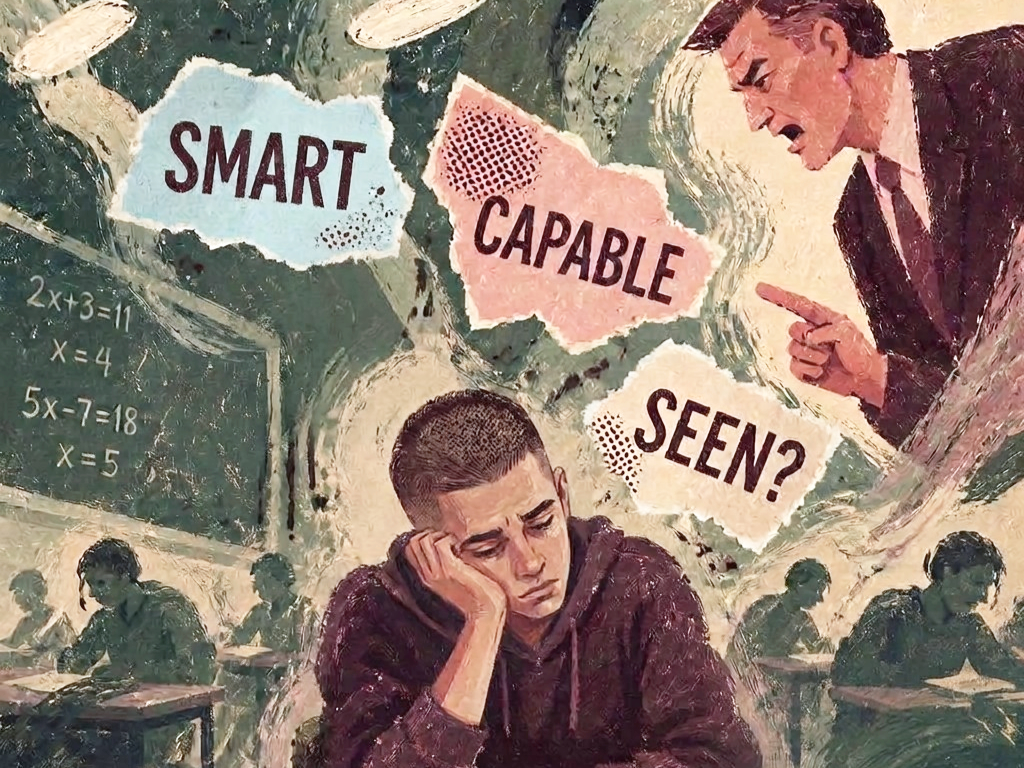
AI-generated image created using Gamma (2026).
I have always considered myself a sharp learner. Smart. Capable.
Why did I struggle in school, wondering if I would even graduate?
I think back to 10th grade. I came into school sick one day, despite my best efforts to stay home. I had a runny nose, a deep cough, and could barely stay awake. Zero ability to focus. After what felt like days, I stepped into Algebra, my third class of the day. The first half was a lecture, and I tried my best to pay attention, but I was not able.
When it came time to work on some practice problems, my teacher called me up to his desk. I thought, finally someone noticed. I can go home. Instead, he questioned my respect for him, for the class, and my desire to learn, as if I was offending him and his profession. I remember feeling appalled that my teacher judged me solely on my disengagement, despite the fact I was obviously sick.
A couple months later, I failed that course. A smart, capable learner.
Which leads me to wonder: If we misunderstand the learner, can we truly understand their learning?
I do not want to rewrite my school experience as though every struggle was someone else’s fault. I was responsible for my behavior, including not completing assignments or calling in sick on days where I felt fine. However, taking responsibility and understanding the reasons behind my behavior are not mutually exclusive.
I have grown to appreciate the complexity of learning and how it is influenced by cognitive processes, conditioned behavior, social dynamics, and cultural influences. Yet no single factor tells the full story of learning (National Academies of Sciences, Engineering, and Medicine [NASEM], 2018).
Cognitivism focuses on how learners process and make sense of information internally, rather than simply by receiving information from an external source (Ackermann, 2001). Through that lens, my illness affected my ability to process information. My observable behavior reflected my condition at that time, but not my overall willingness or capacity to learn. In that exchange, my teacher judged me on observable behavior alone.
What might schools fail to understand about learners when they assume mainly by what they observe?
Thinking back on my experiences, it is easy to see why behaviorism has such a strong connection to learning in schools (Gill et al., 2015). Assignments, participation, and grades all involve observable behavior and consequences through reinforcement and punishment. Does compliant behavior necessarily equate to learning, or does noncompliance mean that a student is not learning?
Moving beyond cognitivism and behaviorism, the social environment surrounding learning becomes critical. My relationships with teachers and classmates were strained by negative experiences and bullying, including my 10th grade math teacher. Looking through a Social Learning Theory lens, learning does not happen alone; it is influenced by the people and the environment around that learner (Bandura, 1971). My learning environment was not favorable; the attitudes, behaviors, and interactions I observed from those around me affected my engagement with school. I could learn and learn well, yet I failed the math course and struggled in school. I was bullied. I had problems at home. Is that reflective of me as a poor learner?
From a critical perspective, the learning environment matters to how learners experience and engage with learning (Lacoe, 2020). They need to feel safe in their learning environment. They can be wrong, ask questions, admit they don’t understand, disagree respectfully, and bring their experiences into the learning environment (Maboloc, 2020). Students are people, not just students. In that moment with my math teacher, assumptions about my observable behavior damaged my willingness to engage in the learning process.
But does that mean I am unable to learn?
No single theory explains my experience. I was physically unable to focus, my behavior was interpreted as disengagement, and that interpretation damaged my relationship with my teacher and the classroom environment. A critical perspective considers the learner as a whole person within the environment in which learning occurs (Maboloc, 2020).
My understanding of learning has changed. I no longer see it as simply receiving and processing information, but as a process involving social interaction, culture, and the health of the learning environment.
So, how does our understanding of the learner influence our understanding of their learning process? It is everything. There is no learning without the learner.
Despite these memorable experiences, my story has a happy ending. Summa Cum Laude in my bachelor’s program. Continuing education, both personally and professionally. The smart, capable, and curious student who struggled in school and the adult learner who excelled are the same person.
References
Ackermann, E. (2001). Piaget’s constructivism, Papert’s constructionism: What’s the difference. Future of Learning Group Publication, 5(3), 1–11.
Bandura, A. (1971). Social learning theory. General Learning Press..
Gill, D., Pheley, A., & Van Dijk, J. (2015). Learning theories 101: Application to everyday teaching and scholarship. Advances in Physiology Education, 39(4), 278–280. https://doi.org/10.1152/advan.00164.2015
Lacoe, J. (2020). Too scared to learn? The academic consequences of feeling unsafe in the classroom. Urban Education, 55(10), 1385-1418. https://doi.org/10.1177/0042095916674059
Maboloc, C. R. (2020). Critical pedagogy in the new normal: Teaching values-based education online. Voices in Bioethics, 6. https://doi.org/10.7916/vib.v6i6888
National Academies of Sciences, Engineering, and Medicine. (2018). How people learn II: Learners, contexts, and cultures. The National Academies Press. https://doi.org/10.17226/24783